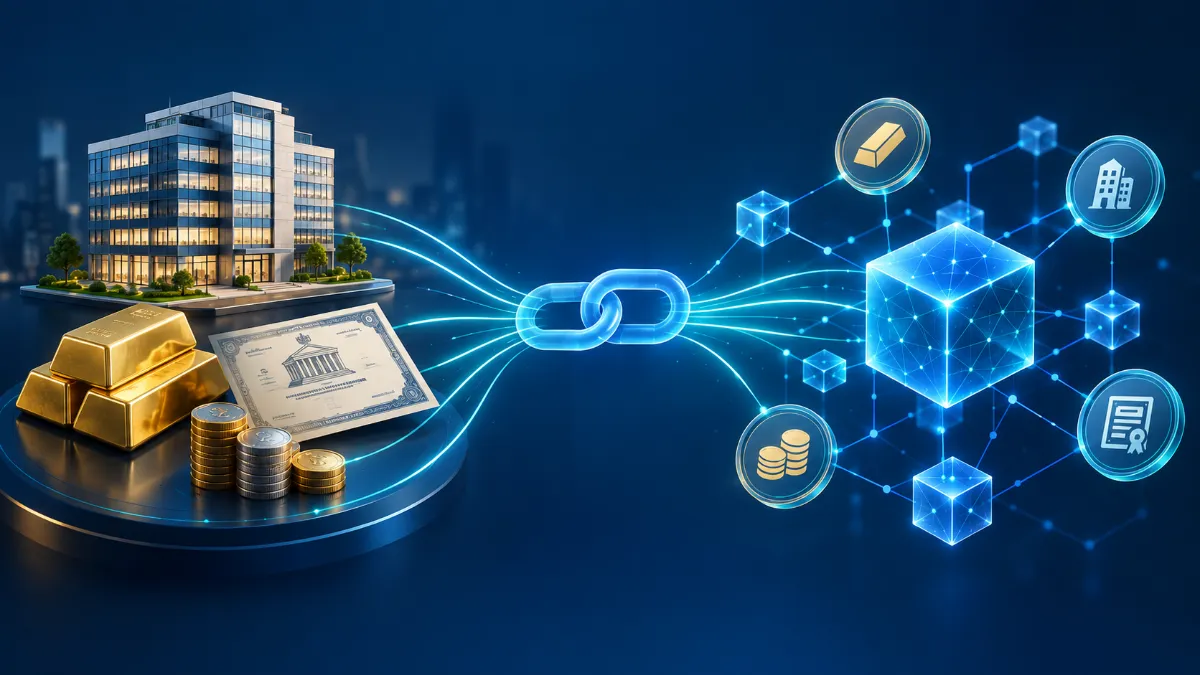
For most of financial history, assets like real estate, government bonds, gold and company shares have lived inside their own separate systems. A property deed sits in a land registry. A government bond sits in a settlement system run by a central bank or clearing house. A share of stock sits in a brokerage account. These systems work, but they were built decades or centuries before blockchain existed, and they were not designed to talk to each other.
Real-World Assets, usually shortened to RWA, is the term the crypto and finance industry now uses for the effort to connect these traditional assets, or the legal and economic rights tied to them, with blockchain-based infrastructure. This connection is usually called tokenization.
In simple terms:
- RWA is the category of traditional assets being represented on blockchain.
- Tokenization is the process used to create that representation.
- RWA tokens are the blockchain-based units that result from this process.
Financial institutions, from asset managers to banks, have become interested in this space because tokenization can potentially improve how assets settle, how they are distributed, and how finely they can be divided among investors. BlackRock, Franklin Templeton and other large asset managers have already launched tokenized products, and government bodies in multiple countries are actively writing rules for this market.
It is important to set expectations correctly from the start. Blockchain does not automatically make a traditional asset better, safer or more valuable. Tokenization can potentially improve areas such as settlement speed, programmability, distribution reach and fractional ownership, but whether any of that actually happens depends on the legal structure behind the token, the asset itself, the technology used and the market that develops around it. A poorly structured tokenized asset is not safer just because it lives on a blockchain.
By the end of this guide, you should understand what RWA means, how tokenization actually works step by step, what different types of RWAs exist, how RWA connects to DeFi, what risks are involved, how regulation is developing around the world, and what to check before you consider using or investing in an RWA product.
1. What Are Real-World Assets (RWA)?
1.1 RWA Meaning
Real-World Assets, commonly abbreviated as RWA, are physical or traditional financial assets that are represented or connected to blockchain-based tokens or systems. The term is broad and covers many different asset categories, including:
- Real estate
- Government securities (like Treasury bills and bonds)
- Corporate bonds
- Private credit (private loans and debt)
- Gold and other precious metals
- Commodities
- Stocks and other equities
- Investment funds
- Infrastructure projects
- Other financial or physical assets
The common thread is that these assets exist, and have always existed, outside of blockchain systems. RWA tokenization is the bridge that attempts to connect them to blockchain-based infrastructure.
1.2 What Does RWA Mean in Crypto?
Inside Web3 and crypto communities, “RWA” is shorthand for this entire category of tokenized traditional assets. But there is a distinction every reader should understand clearly before going further:
An RWA token is not necessarily the physical asset itself.
Depending on how it is legally structured, a token connected to a real-world asset may represent:
- Direct ownership
- A fractional ownership interest
- A security (in the legal/regulatory sense)
- A debt claim
- An interest in a fund
- A contractual claim against an issuer
- Simple economic exposure to the price of an underlying asset, without any ownership rights at all
This means two tokens that both claim to represent “gold” or “real estate” can carry completely different legal rights. One token might give you a real claim on a specific vault of gold bars. Another might just track the gold price without giving you any claim on physical metal. Reading the legal documentation behind any RWA token is essential, and this guide will return to this point repeatedly.
2. What Is RWA Tokenization?
RWA tokenization is the process of representing an asset, or the legally defined rights associated with an asset, through blockchain-based tokens.
To understand why this matters, it helps to compare how a traditional asset moves through the financial system versus how a tokenized asset does.
Traditional asset path:
Property
   ↓
Legal ownership
   ↓
Paper/digital records
   ↓
Traditional financial infrastructure
Tokenized asset path:
Underlying asset
       ↓
Legal structure
       ↓
Custody / ownership
       ↓
Tokenization
       ↓
Blockchain token
       ↓
Transfer / settlement / distribution
Notice that the tokenized path does not skip the legal structure and custody steps. It adds blockchain infrastructure on top of them. This is a point worth repeating: blockchain does not eliminate the legal and financial infrastructure surrounding the underlying asset. Someone still has to legally own the property, hold the gold in a vault, or manage the bond portfolio. Tokenization changes how ownership and transfer are recorded and moved, not the underlying legal reality of who owns what.
3. How Does RWA Tokenization Work? (Step by Step)
Tokenizing a real-world asset generally involves the following stages.
Step 1: Identify the Asset
An issuer identifies an asset suitable for tokenization, such as a property, a portfolio of Treasury securities, a gold reserve, a pool of private loans, or an investment fund.
Step 2: Verify the Asset
Before any tokens are created, the asset typically needs:
- Ownership verification
- Independent valuation
- Proper documentation
- Auditing
- Legal and financial due diligence
Skipping this step is one of the biggest sources of fraud risk in the RWA space, which is covered later in the risks section.
Step 3: Establish the Legal Structure
The issuer sets up a legal entity to hold or control the asset. This is commonly:
- A company
- A Special Purpose Vehicle (SPV)
- A fund
- A trust
- Another type of legal entity, depending on jurisdiction
The exact structure varies significantly by country and by the type of asset being tokenized.
Step 4: Establish Custody
Someone has to be legally responsible for safeguarding the underlying asset. This could be a bank, a qualified custodian, a trustee, a fund administrator, or another regulated institution, depending on the asset type and jurisdiction.
Step 5: Define What the Token Represents
This is arguably the single most important step for any investor to understand. The token may represent:
- Direct ownership
- A beneficial interest
- A debt claim
- Fund shares
- Economic rights only, with no ownership
- A contractual claim against the issuer
Two tokenized products that look similar on the surface can have completely different legal substance behind them, purely because of how this step was structured.
Step 6: Create the Token
A blockchain smart contract is used to define technical parameters, including:
- Token supply
- Ownership records
- Transfer rules
- Whitelisting (restricting who can hold or receive the token)
- Compliance restrictions
- Distribution mechanisms for income or dividends
Step 7: Issue the Tokens
Tokens are distributed to eligible investors or users. Some tokenized products are broadly accessible, while others carry restrictions such as:
- KYC (Know Your Customer) requirements
- Accredited or institutional investor requirements
- Geographic restrictions
- Transfer restrictions that limit who can buy the token later
Step 8: Secondary Trading
Some RWA tokens can be freely transferred or traded on secondary markets. Others have very limited liquidity, meaning there may be few or no buyers even if the token is technically transferable. Tokenization by itself does not guarantee that a liquid market for the token will exist.
Step 9: Income Distribution
Depending on the underlying asset, token holders may receive periodic distributions such as interest, rental income, dividends, fund distributions, or other cash flows, if the legal and token structure is designed to pass these through.
Step 10: Redemption
Eventually, investors may want to exit their position. Depending on the specific product, this could involve:
- Selling the token on a secondary market
- Redeeming the token directly through the issuer
- The underlying asset being sold and proceeds distributed
- Receiving cash distributions according to the legal agreement
The exact redemption mechanism, including any waiting periods or restrictions, depends entirely on the specific product’s legal documents.
4. What Is Behind an RWA Token?
An RWA ecosystem typically involves several distinct participants and components, and understanding each one helps you evaluate any RWA product.
Underlying Asset – The actual asset or financial instrument being tokenized, such as a property, a bond, or a gold reserve.
Issuer – The organization responsible for creating and issuing the tokenized product.
Legal Entity – The entity (often an SPV, fund, or trust) that legally owns or controls the underlying asset.
Custodian – The institution responsible for holding or safeguarding the underlying asset where applicable.
Blockchain – The network on which the token is issued and transferred.
Smart Contract – The software that enforces token-related rules, such as transfer restrictions or distribution logic.
Oracle / Data Provider – A system that feeds external, off-chain information into blockchain applications, such as asset prices, Net Asset Value (NAV), interest rates, or valuation updates.
Investor – The person or institution that ultimately holds the token.
When evaluating any RWA product, it is worth identifying each of these pieces individually, because a weakness in any single layer, whether it is the custodian, the smart contract, or the oracle, can affect the safety of the whole structure.
5. Types of Real-World Assets
5.1 Tokenized Real Estate
Real estate tokenization can apply to residential property, commercial property, rental properties, real-estate funds, and fractional ownership structures. The potential benefit is that a large, illiquid asset like a building can be divided into smaller economic interests that more investors can access.
It is important not to assume that buying a real-estate token automatically means owning part of a building. The legal structure determines what rights the token holder actually receives. In many current structures, buying a token gives you an interest in a legal entity (like an SPV) that owns the property, rather than a direct deed to a fraction of the building itself. Some jurisdictions, such as India, have created specific regulatory categories (like Small and Medium REITs) that fractional real-estate platforms are now expected to register under.
5.2 Tokenized Government Bonds and Treasury Securities
This category includes Treasury bills, government bonds, money-market funds, and other tokenized government securities. It has become one of the largest and fastest-growing segments of the RWA market, largely because government securities are relatively simple to value, carry lower credit risk than many other asset types, and are attractive to institutions that want on-chain access to a familiar, well-understood asset.
Key discussion points for this category include the yield the underlying Treasuries pay, how settlement works on-chain versus through traditional systems, and the level of institutional adoption, which has been substantial. Large asset managers including BlackRock and Franklin Templeton have launched tokenized government-security funds.
5.3 Tokenized Private Credit
Private credit tokenization covers private loans, corporate lending, institutional credit, invoice financing, and other private debt. Tokenization can potentially make these credit positions easier to distribute to a wider pool of lenders and easier to integrate with blockchain-based financial applications.
Credit risk remains just as real in tokenized form as it is in traditional private credit. If a borrower defaults, token holders can lose money regardless of the blockchain infrastructure underneath the product. Tokenized private credit has already experienced real defaults in past years, which is a useful reminder that tokenization does not remove credit risk.
5.4 Tokenized Gold
Gold tokenization can involve physical gold-backed structures, gold ownership claims, and custody arrangements where a custodian holds physical bars on behalf of token holders. There is an important difference between:
Buying physical gold, where you take direct possession or have a specific allocated claim, versus
Holding a token representing a claim connected to gold, where your rights depend entirely on the issuer’s legal documentation and the custodian’s reliability.
5.5 Tokenized Silver
Silver tokenization works on a similar principle to gold tokenization, but it is worth treating as its own category because silver has different market dynamics. Silver is used heavily in industrial applications, such as electronics and solar panels, alongside its role as an investment metal, so its price can behave differently from gold’s, which trades more purely as a monetary and safe-haven asset.
A tokenized silver product typically involves a custodian holding physical silver, often in bar or coin form, in a vault, while the token represents a claim connected to that stored metal. As with gold, the same core distinction applies:
Buying physical silver, where you hold or have an allocated claim on specific metal, versus
Holding a token that represents a claim connected to silver, where your actual rights depend on the issuer’s legal terms and how reliable the custodian is.
Because silver is generally less valuable per unit weight than gold, tokenization can make it easier to divide into very small, affordable denominations, which may appeal to investors looking for lower-cost exposure to precious metals. At the same time, storage and insurance costs relative to the value of the metal can be higher for silver than for gold, since more physical volume is needed to represent the same dollar value, which is a detail worth checking in any specific product’s fee structure.
5.6 Tokenized Commodities
Beyond gold and silver, this category can include oil, agricultural commodities, and other commodity exposures. As with precious metals, the legal and economic structure of each specific token needs to be examined individually. Some may represent direct claims, while others may only track price movements synthetically.
5.7 Tokenized Stocks and Equities
Tokenized equity products can range from tokens intended to represent direct ownership, to synthetic exposure that simply tracks a stock’s price without transferring any shareholder rights. This is an area that requires particular care. Not every token representing the price of a stock gives the holder legal ownership, voting rights, or the other legal protections that come with owning shares directly through a traditional brokerage.
5.8 Tokenized Funds
This includes tokenized money-market funds, bond funds, private funds, and other investment funds. For these products, understanding Net Asset Value (NAV) and how fund ownership is calculated and passed through to token holders is central to understanding what you actually hold.
5.9 Tokenized Infrastructure
Some projects are exploring tokenization of infrastructure assets such as energy projects, transportation assets, data centers, and renewable energy installations. This category is generally earlier-stage and less standardized than Treasuries or private credit.
5.10 Other Potential RWAs
Other categories being explored include intellectual property, collectibles, art, royalties, carbon credits, equipment, and receivables. Whether tokenization is actually feasible for any of these depends heavily on clear legal ownership, reliable valuation, secure custody arrangements, and whether real market demand exists for a tokenized version of the asset.
6. Real-World Asset Examples
| Asset | What Could Be Tokenized? | Potential Economic Return |
|---|---|---|
| Treasury | Interest-bearing security or fund interest | Interest |
| Real estate | Ownership or economic interest | Rent or appreciation |
| Gold | Claim connected to physical gold | Gold price movement |
| Private credit | Loan or debt interest | Interest |
| Fund | Fund interest | Fund returns |
| Stock | Equity or security interest, or price exposure | Price movement or dividends where applicable |
Important: These examples describe possible structures only. The actual rights attached to any specific token depend on the issuer, the legal documents behind that particular product, and the jurisdiction it operates in.
7. RWA Tokenization Example: A $1 Million Property
Here is a simple, illustrative example to make the process concrete.
Suppose a property is valued at $1,000,000. A hypothetical tokenization structure could divide the economic interest in that property into 1,000,000 tokens, so that at a purely illustrative level, 1 token equals $1 of the structured interest.
A simplified version of what might happen next:
- The property is legally acquired by a legal entity, such as an SPV.
- That legal entity holds the property and its associated rights.
- Investors purchase interests connected to that legal entity, represented as tokens.
- The tokens represent whatever rights were defined in the legal documents, such as a share of rental income or a share of any future sale proceeds.
- Rental income, if any, may be distributed to token holders according to the legal structure.
- Investors may transfer their tokens to others if the structure permits it.
- Redemption or exit depends entirely on what the legal documents say and whether a market for the token exists.
This is an illustrative example only, not an investment recommendation or a description of a standardized legal structure. Real tokenized real-estate products vary widely in how they are structured.
8. Why Are RWAs Important?
Bringing traditional assets into blockchain infrastructure has several potential benefits, though it is important to treat all of them as potential rather than guaranteed.
Fractionalization – A large asset may potentially be divided into smaller interests, letting more investors participate with smaller amounts of capital.
Programmability – Smart contracts can automate certain processes, such as distributing income or enforcing transfer restrictions.
Faster Settlement – Blockchain infrastructure may enable faster settlement for certain transactions compared to traditional, multi-day settlement cycles.
Transparency – Blockchain records can provide transparent transaction histories, though this transparency is limited to whatever information is actually placed on-chain.
Global Distribution – Tokenized products may potentially be distributed digitally across jurisdictions, though this remains subject to local regulation in each market.
Integration With DeFi – Tokenized assets may potentially be used as collateral or building blocks within blockchain-based lending and financial applications.
9. Benefits of RWA Tokenization
Fractional Ownership – Large assets, like commercial buildings or big bond issuances, can potentially be divided into smaller interests that are more accessible to a wider range of investors.
Greater Accessibility – Tokenization may reduce some traditional barriers to entry, such as high minimum investment amounts, although regulatory restrictions like accredited-investor rules can still apply and limit who can actually participate.
Faster Settlement – Blockchain-based settlement can, in some cases, be significantly faster than traditional multi-day clearing and settlement processes.
Transparency – On-chain transaction records can be publicly viewable, creating a transparent history of transfers, subject to what data the issuer chooses to put on-chain.
Programmability – Smart contracts can automate rules such as who can hold a token, how distributions are calculated, and when transfers are permitted.
Potential Liquidity – Tokenization could potentially make certain traditionally illiquid assets easier to transfer or trade. However, it is important to understand that tokenization does not automatically create liquidity. A token can exist on a blockchain and still have very few, or no, willing buyers.
Automated Distributions – Smart contracts can potentially automate the distribution of interest, dividends, rental income, or other fund distributions directly to token holders.
Reduced Operational Friction – Certain administrative processes, like record-keeping and reconciliation, may potentially be automated, reducing manual back-office work for issuers.
10. Risks of Real-World Assets
This is one of the most important sections in this guide, because RWA products combine risks from both the traditional financial world and the blockchain world.
Regulatory Risk – Rules differ between jurisdictions and between asset types, and regulations are still actively evolving in most major markets. A product legal in one country may not be legal, or may be treated very differently, in another.
Legal Ownership Risk – It is critical to understand exactly what the token legally represents. As discussed earlier, a token might represent direct ownership, a claim against an issuer, or simple price exposure with no ownership rights at all.
Custody Risk – If the entity holding the underlying asset, whether it’s a bank, trustee, or other custodian, fails or mismanages the asset, token holders can be directly affected.
Issuer Risk – If the company or entity that issued the token becomes insolvent, token holders may face significant uncertainty about recovering their investment, depending on the legal structure.
Smart Contract Risk – Smart contracts can contain bugs, vulnerabilities, or implementation errors that could be exploited or that could cause the contract to behave unexpectedly.
Oracle Risk – Many blockchain applications rely on oracles to bring in external data like prices or NAV. If that external data is incorrect, delayed, or manipulated, it can affect how the application behaves.
Liquidity Risk – A token may technically exist and be transferable, but there may still be very few buyers, meaning holders could struggle to sell when they want to exit.
Valuation Risk – Some underlying assets, particularly private assets like real estate or private credit, can be difficult to value accurately and consistently.
Redemption Risk – Investors may not always be able to immediately redeem tokens for cash or for the underlying asset. Redemption windows, minimum holding periods, or issuer discretion can all limit an investor’s ability to exit quickly.
Counterparty Risk – An investor in an RWA product often depends on several different institutions at once, including the issuer, the custodian, the legal entity, and sometimes an oracle provider, each of which introduces its own risk.
Fraud and Asset Verification Risk – Because tokens are digital, it can be easy to create a token that claims to represent a real asset without adequate proof that the asset actually exists or is properly owned. Independent verification of the underlying asset matters a great deal.
Cybersecurity Risk – This includes risks around private key security, smart contract vulnerabilities, wallet security, and the possibility of platform-level attacks or hacks.
Blockchain Risk – Potential issues include network outages, network congestion, unpredictable transaction fees, and vulnerabilities specific to the particular blockchain being used.
11. RWA vs Traditional Assets
| Feature | Traditional Asset | Tokenized RWA |
|---|---|---|
| Ownership record | Traditional systems | Blockchain plus legal infrastructure |
| Settlement | Traditional rails | Potentially blockchain-based |
| Trading hours | Often market-dependent | Potentially extended or 24/7 |
| Fractionalization | Depends on the asset | Potentially easier |
| Transparency | Depends on the institution | On-chain transaction visibility |
| Custody | Traditional custody | Legal custody plus digital custody |
| Programmability | Limited | Smart contracts can automate rules |
| Regulation | Established framework, varies by asset | Existing rules plus token-specific considerations |
It is important not to treat this table as proof that tokenized assets are automatically superior. Each row represents a potential difference, not a guaranteed advantage, and the actual experience depends heavily on the specific product and issuer.
12. RWA vs Cryptocurrency
It helps to draw a clear line between cryptocurrency and RWA tokens, since the two are often discussed in the same breath but are fundamentally different things.
Cryptocurrency is a native digital asset created within a blockchain ecosystem. Bitcoin and Ether are the clearest examples: they were not designed to represent any external, off-chain asset. Their value comes from the blockchain network itself, not from a legal claim on something outside it.
An RWA token, on the other hand, is a blockchain-based representation connected to an asset, security, fund, debt instrument, or legal claim that originates outside the blockchain.
To put it simply:
Bitcoin → a native digital asset with no external claim.
A tokenized Treasury bill → a blockchain representation of a traditional financial asset or interest that exists because of an off-chain legal structure.
13. RWA vs NFTs
NFTs (Non-Fungible Tokens) and RWAs can overlap, but they are not identical concepts.
An NFT is a unique blockchain token that can represent digital or physical assets, ranging from digital art to collectibles to, in some cases, real-world property claims.
An RWA focuses specifically on real-world assets and their economic or legal representation on-chain, regardless of whether the token standard used happens to be fungible or non-fungible.
In practice, an RWA could technically use an NFT-like token standard, for example to represent a unique property or unique piece of art. But not every NFT is an RWA. Most NFTs represent purely digital items with no connection to any off-chain asset at all.
14. RWA and DeFi
Real-World Assets are relevant to decentralized finance (DeFi) because tokenized versions of traditional assets can potentially be used within DeFi applications the same way native crypto tokens are.
A simplified flow looks like this:
Traditional Asset
       ↓
Tokenization
       ↓
Blockchain
       ↓
DeFi Application
       ↓
Lending / Borrowing / Collateral
Within this flow, RWAs can potentially be used as collateral for loans, deposited into lending and borrowing protocols, paired with stablecoins, used to generate yield, or built into other automated financial applications.
However, regulatory and legal restrictions can determine whether a particular RWA token can actually be used in a given DeFi application. Many tokenized products carry whitelisting requirements or transfer restrictions specifically to comply with securities laws, which limits how freely they can move through permissionless DeFi protocols compared to a native cryptocurrency.
15. How Do RWA Tokens Generate Yield?
Understanding where yield actually comes from is one of the most important things a reader can learn from this guide.
Treasury RWA – Yield comes from the interest paid by the underlying government Treasury securities.
Private Credit – Yield comes from interest payments made by the borrowers whose loans have been tokenized.
Real Estate – Returns may come from rental income collected from tenants, or from property appreciation if and when the property is sold.
Funds – Returns come from whatever the underlying securities held by the fund actually earn.
The key concept to understand is this:
Tokenization itself does not create economic yield. The underlying asset or financial activity is what generally generates the return.
It is also worth being direct about a second point: yield is not the same thing as guaranteed profit. Any RWA product that advertises a yield figure is describing a potential return based on the underlying asset’s historical or expected performance, not a promise. Interest rates change, borrowers can default, rental income can fall, and fund returns can be negative.
16. What Are RWA Protocols?
The term “RWA protocol” gets used loosely, so it is worth separating three related but distinct concepts:
RWA infrastructure refers to the underlying technology used to tokenize or manage assets, such as compliance tooling, whitelisting systems, or blockchains purpose-built for RWA issuance.
RWA product refers to an actual tokenized financial product that an investor can hold, such as a specific tokenized Treasury fund or a specific tokenized real-estate offering.
RWA crypto token refers to a cryptocurrency associated with a protocol or project, which may or may not itself represent a real-world asset (some protocol tokens are governance tokens for the platform rather than RWA tokens themselves).
These three concepts should not be treated as interchangeable. A platform’s own crypto token, an RWA infrastructure layer, and an actual tokenized asset product are three different things that happen to share the same industry label.
17. Popular RWA Projects and Platforms
The RWA space includes a range of platforms that each focus on different parts of the tokenization stack. As of 2026, some of the most frequently discussed platforms include Ondo Finance, Centrifuge, Maple Finance, Securitize, Backed Finance, and BlackRock’s BUIDL fund (issued through Securitize’s infrastructure), among others.
Ondo Finance focuses primarily on tokenized U.S. Treasuries and, more recently, tokenized U.S. equities. Its product portfolio includes USDY, a non-U.S. retail secured note backed by Treasuries and bank deposits, and OUSG, a product restricted to U.S. qualified purchasers that is backed primarily by BlackRock’s BUIDL fund. The platform has also expanded into Ondo Global Markets, offering access to more than 100 tokenized U.S. stocks and ETFs.
Centrifuge is one of the longest-running platforms in tokenized private credit. It securitizes invoices, trade finance receivables, and consumer credit pools sourced from off-chain loan originators, generally using a senior and junior tranche structure.
Maple Finance operates differently from treasury-tokenization platforms by focusing on overcollateralized institutional lending rather than passing through government bond yields. Its returns come from credit spreads on private lending rather than Treasury interest, and its main products are yield-bearing stablecoin vaults that generate returns from fixed-rate institutional loans, DeFi liquidity provision, and futures basis trading.
Securitize operates as a regulated transfer agent and issuance platform. It is the platform behind BlackRock’s BUIDL fund, as well as several tokenized funds from Apollo and Hamilton Lane.
Backed Finance focuses on issuing tokens that are collateralized wrappers of public equities and ETFs, giving holders synthetic price exposure to those securities.
For any specific project, always check the platform’s own official documentation for the latest figures on assets under management, supported blockchains, and eligibility requirements, since these details change frequently in this fast-moving industry.
Do not treat any list of RWA projects as a ranked “best” list. Different platforms serve different asset classes, investor types, and regulatory structures, so the right choice depends entirely on what an investor is trying to access and what eligibility requirements they can meet.
18. What Is BlackRock BUIDL?
BlackRock’s USD Institutional Digital Liquidity Fund, known as BUIDL, is one of the most closely watched products in the RWA space because of BlackRock’s scale as the world’s largest asset manager.
BUIDL is a tokenized Treasury-backed money market fund that launched in March 2024 and reached over $2.8 billion in total asset value by July 2026, according to RWA.xyz. The fund has distributed over $100 million in dividends since inception and is deployed across multiple blockchains, including Ethereum, Solana, Polygon, Avalanche, Arbitrum, Optimism, Aptos, and BNB Chain. In February 2026, BUIDL began trading on Uniswap, marking the first time a regulated institutional product of this kind was placed on a decentralized exchange.
The underlying assets behind BUIDL are short-term U.S. Treasury securities and cash, which is why the fund is often used as a benchmark for the broader tokenized Treasury category. BlackRock’s entry into this space, alongside Securitize as its transfer agent and tokenization partner, is frequently cited as a major signal of institutional confidence in RWA infrastructure. As always, current fund size, distribution networks, and eligibility requirements should be checked against BlackRock’s own official fund documentation, since these details are updated regularly.
A comparable product worth knowing about is Franklin Templeton’s OnChain U.S. Government Money Fund, represented by the BENJI token. Launched in 2021, it was the first U.S.-registered mutual fund to use a public blockchain as its official system of record, and it reached $2.44 billion in total asset value by July 2026.
19. RWA Market Size
One of the most confusing things for newcomers to this space is that different reports state very different RWA market sizes. This is not necessarily because any one source is wrong. It happens because different datasets define “RWA” differently. For example, a report might measure only tokenized securities, only tokenized financial assets, only tokenized commodities, stablecoins as a category on their own, or a much broader definition of “on-chain assets” that includes all of the above.
Because of this, this guide will never state that “the RWA market is exactly $X.” Instead, every figure will be stated with its source, date, and methodology attached.
As one useful illustration of how differently this can be measured: analysis using RWA.xyz as a reference dataset found that, as of roughly March 2026, distributed RWA value across public blockchains, meaning tokens that can actually move peer-to-peer, stood at about $26.66 billion, while a much larger figure of $342.60 billion represented assets that sit on a ledger but cannot be freely transferred outside the issuer’s own platform. This distinction between “distributed” and “represented” assets is now treated as a standard way of separating genuinely liquid, composable tokens from assets that are simply using a blockchain as an internal record-keeping system.
By August 2026, RWA.xyz reported that the RWA crypto market held approximately $37.89 billion in distributed asset value, against roughly $365.15 billion in off-chain collateral committed to backing those tokens, according to RWA.xyz data dated August 6, 2026. That same data showed the number of wallets holding a tokenized asset had grown much faster than the dollar value itself over the prior 30 days, suggesting the market was expanding more through new participants than through large new capital inflows at that particular moment.
Separately, KuCoin Research reported that in early 2026, on-chain tokenized RWAs excluding stablecoins stood in the range of $19 billion to $36 billion, based on RWA.xyz data, following what it described as growth exceeding 300 percent in the prior period.
By contrast, a market-research report from Research and Markets, using an entirely different methodology focused on the broader RWA tokenization industry (including software, services, and infrastructure spending rather than only the dollar value of tokens issued), estimated the market at $0.67 billion in 2025, growing to $0.76 billion in 2026, and projected to reach $1.21 billion by 2030.
These numbers look wildly different from each other, which is exactly the point of this section: always check what is actually being measured before comparing RWA market-size figures from different sources.
20. Why Do RWA Market Estimates Differ?
There are several concrete reasons why RWA market-size estimates vary so widely between sources:
- Different definitions of what counts as an RWA in the first place.
- Different datasets, since not every data provider tracks every blockchain or every issuer.
- Different valuation methods for hard-to-price private assets.
- Different treatment of stablecoins, which some reports include as part of the broader RWA category and others exclude entirely.
- Different treatment of private, permissioned assets versus publicly transferable tokens (the “distributed” versus “represented” distinction discussed above).
- Different reporting dates, since this is a fast-growing market where a few months can meaningfully change the total.
- Different methodologies, such as measuring token issuance value versus industry revenue versus total addressable market projections.
Because of this, whenever you see an RWA market-size figure anywhere, including in this guide, look for the source, the date, and ideally a note on what is actually included in that number.
21. RWA Market Growth and Institutional Adoption
Even with the differences in exact figures, most sources agree on the general direction: on-chain tokenized asset value has grown substantially over the past two years, and institutional participation has increased alongside it.
Tokenized U.S. Treasuries have been the clearest growth story within the category. Data cited in coverage of the space in mid-2026 put tokenized Treasuries at roughly $12.88 billion to $16.17 billion depending on the reporting date and source, making this by far the largest single RWA category tracked on public blockchains. Tokenized gold and tokenized stocks have also shown fast percentage growth off smaller bases, with tokenized stocks in particular expanding rapidly following a NASDAQ rule change referenced in coverage from March 2026.
On the institutional side, banks, asset managers, and fintech companies have moved from cautious experimentation toward active product launches. BlackRock’s BUIDL fund, Franklin Templeton’s BENJI-tokenized fund, and infrastructure built by companies like Securitize illustrate this. It would be inaccurate to say “all banks are adopting RWA,” since adoption remains concentrated among a relatively small number of large, well-resourced institutions so far, alongside a wider layer of crypto-native platforms like Ondo, Centrifuge, and Maple Finance building the surrounding infrastructure. Government-level interest has also emerged: for example, in September 2026, the Reserve Bank of India’s governor described a pilot combining wholesale central bank digital currency with corporate bond tokenization, developed jointly with India’s securities regulator, alongside a real-world example of an Indian company raising roughly ₹500 crore through tokenized bonds.
22. RWA Regulation
Regulation is widely considered one of the biggest challenges facing RWA adoption, because tokenized products sit at the intersection of securities law, banking law, and technology regulation, often all at once. Key areas that regulators and issuers need to address include:
- Securities law classification
- Financial licensing requirements
- KYC (Know Your Customer) obligations
- AML (Anti-Money Laundering) obligations
- Custody rules
- Investor eligibility requirements
- Transfer restrictions
- Tax treatment
- Cross-border regulatory questions
- Consumer protection standards
Because these rules differ by country, and often by the specific type of underlying asset, no single global standard currently governs RWA tokenization. This section is not legal advice; it is a general overview of how different regions are currently approaching the topic, and readers considering any specific product should consult the issuer’s own regulatory disclosures and, where appropriate, a qualified legal professional.
23. RWA Regulation in the United States
The U.S. regulatory approach has developed gradually rather than through a single comprehensive law written specifically for tokenized assets. According to a 2025 report from the President’s Working Group on Digital Asset Markets, the regulatory framework that applies to an RWA is determined by the nature of the underlying asset it represents, not by the blockchain technology used to issue it. In practice, this means a tokenized security is still generally regulated as a security under U.S. law.
Historically, U.S. securities law analysis for tokens has relied heavily on the Howey test, used by the Securities and Exchange Commission (SEC) to determine whether something qualifies as an “investment contract” and therefore a security. Because most tokenized RWAs are structured with an explicit focus on yield generation or value appreciation, they will generally be treated as securities under the Securities Act of 1933, covering both tokens that represent traditional securities like stocks and bonds, and tokens representing interests in physical assets where the goal is receiving payment streams or price appreciation.
As of early 2026, the United States still had not implemented a comprehensive regulatory regime written specifically for tokenized securities, so issuers have needed to fit tokenized RWAs into the existing securities-law framework. A common approach for broadly available offerings has been to rely on exemptions such as Regulation D, generally restricting sales to accredited investors.
Several developments through 2026 have added more structure to this picture. In March 2026, the SEC and the Commodity Futures Trading Commission (CFTC) released a joint interpretation sorting crypto assets into categories including digital commodities, digital collectibles, digital tools, stablecoins, and digital securities, marking the first coordinated, binding classification framework published jointly by the two agencies. Separately, coverage from early 2026 noted that the SEC closed its investigation into Ondo Finance without bringing charges, which industry commentary described as a validating signal for compliant tokenized Treasury products, while the CFTC launched a pilot program addressing tokenized collateral in derivatives markets. Firms operating in this space have generally been advised to prepare for a dual SEC and CFTC framework, aligning tokenized securities and RWAs with existing securities laws, custody requirements, and auditable recordkeeping, since tokenization is being treated as a new delivery method for existing asset classes rather than as a new legal asset category in itself.
24. RWA Regulation in Europe
The European Union has taken a more centralized legislative approach than the United States, through the Markets in Crypto-Assets Regulation, known as MiCA. (See ESMA’s official MiCA overview for the full regulatory text and current guidance.) MiCA is designed to create a harmonized regulatory regime across all EU member states, covering how crypto-assets are issued, how service providers operate, and how market integrity is maintained. It distinguishes between several categories of crypto-assets, including asset-referenced tokens, e-money tokens, and other crypto-assets, and requires service providers to obtain Crypto-Asset Service Provider authorization, which then allows passporting of that authorization across the entire EU. MiCA’s full enforcement date, marking the end of transitional provisions for firms, was set for June 30, 2026.
Separately from MiCA, tokenized financial instruments in the EU may also fall under existing frameworks such as MiFID II, depending on how the instrument is classified. This means a single tokenized product in Europe can potentially be subject to both MiCA (for the crypto-asset service provider layer) and traditional securities regulation (for the underlying financial instrument), depending on its structure.
25. RWA Regulation in Asia
Regulatory approaches across Asia vary substantially by country, and there is no single regional standard.
Singapore has been frequently cited as offering one of the clearer compliance pathways in the region for RWA tokenization platforms, through the Monetary Authority of Singapore’s (MAS) regulatory framework for tokenized securities, with reported licensing timelines in the range of four to six months in industry commentary from 2026.
Hong Kong and Japan both have their own evolving frameworks for digital assets and securities tokenization, and secondary market liquidity for RWA tokens has been described as growing on licensed exchanges in jurisdictions including Switzerland, Singapore, and Abu Dhabi.
The UAE, including Abu Dhabi’s regulatory environment, has also been referenced as an emerging hub offering licensed venues for RWA token trading.
Because the regulatory posture in each of these markets can change quickly, and because a product legal in one Asian jurisdiction may not be legal in a neighboring one, always check the most current guidance from the specific national regulator relevant to any product being considered.
26. RWA Regulation in India
India is a particularly important market to cover in detail because of its large investor base and its historically strong cultural interest in assets like gold and real estate, which makes it a natural audience for RWA products, even though its regulatory framework is still developing.
As of 2026, India does not have a single, finalized, comprehensive regulatory framework written specifically for tokenized RWAs. Analysis published in 2026 has described India’s regulatory posture as a legal grey zone in several respects: the Securities Contracts (Regulation) Act, 1956, and the SEBI Act, 1992, were not written with tokenized assets in mind, and there is ongoing legal debate about whether tokenized real-world assets fall within the existing definition of a “security” under Indian law. If they are treated as securities, India’s existing investor-protection framework under the Securities and Exchange Board of India (SEBI) would apply, including disclosure obligations and market-conduct standards. If they are not classified as securities, but still provide investors with returns similar to a security, current protections may be much weaker.
That said, specific regulatory activity has picked up in certain areas:
- Real estate: Following amendments to SEBI’s Real Estate Investment Trusts regulations in 2024, fractional real-estate platforms are now expected to register as Small and Medium REITs (SM REITs), which as of 2026 requires a scheme asset value between ₹50 crore and ₹500 crore and a minimum of 200 investors.
- GIFT City / IFSCA: India’s GIFT City, regulated by the International Financial Services Centres Authority (IFSCA), has emerged as the country’s clearest regulatory sandbox for tokenization, and IFSCA issued a consultation paper specifically on the regulatory approach toward tokenization of real-world assets. Several international tokenization platforms have reportedly set up operations there to serve Indian and NRI (Non-Resident Indian) investors under a more permissive framework than exists on the Indian mainland.
- Taxation: The 30 percent tax regime on Virtual Digital Assets (VDA), introduced in India’s 2022 Budget, continues to apply broadly to crypto and token transactions, alongside applicable capital gains, TDS (Tax Deducted at Source), and GST considerations.
- Cross-border rules: NRI investors accessing tokenized Indian assets must navigate FEMA (Foreign Exchange Management Act) investment limits and Reserve Bank of India (RBI) repatriation rules.
- Parliamentary review: A 2026 parliamentary committee recommended phased crypto regulation and suggested breaking Virtual Digital Assets into distinct legal categories, since not every crypto asset behaves the same way; some may function as securities, some as derivatives, and some may need an entirely new regulatory category. The committee specifically flagged the need for clarity on whether tokenized RWAs would fall within a proposed Securities Markets Code.
- Institutional pilots: In September 2026, the Reserve Bank of India Governor described a pilot combining wholesale central bank digital currency with tokenized certificates of deposit and corporate bond tokenization, developed jointly with SEBI, alongside a real corporate example of a company raising tokenized bonds.
The overall picture is that India’s approach in 2026 can be described as cautious but increasingly structured, with SEBI expected by some industry commentary to publish a more formal RWA tokenization framework in 2027. Anyone evaluating an RWA product available to Indian investors should check the current SEBI, RBI, and IFSCA guidance directly, since this is one of the fastest-moving regulatory areas in the country.
27. How to Invest in Real-World Assets
This section is meant to be educational, not promotional. Before putting any money into an RWA product, work through the following due-diligence process.
Step 1: Understand the underlying asset. What exactly are you getting exposure to? Is it a Treasury bill, a piece of property, a pool of private loans, or something else?
Step 2: Understand the legal structure. Who legally owns the underlying asset? Is it held by an SPV, a trust, a fund, or another entity?
Step 3: Understand the token. What specific rights does the token give you? Direct ownership, a contractual claim, fund shares, or simple price exposure?
Step 4: Verify the issuer. Research the issuing company’s track record, available financial information, and current regulatory status.
Step 5: Check custody. Where is the underlying asset actually held, and by whom?
Step 6: Understand redemption. Can you redeem your token for cash or for the underlying asset, and under what conditions?
Step 7: Check liquidity. Can you actually sell the token if you want to, and where?
Step 8: Understand the fees. Look for issuance fees, trading fees, management fees, redemption fees, and blockchain network fees, since these can add up.
Step 9: Understand the risk. Do not focus only on the advertised yield; weigh it against every risk category covered earlier in this guide.
Step 10: Understand applicable regulations and taxes. These depend heavily on your jurisdiction and the specific product, so check current local guidance rather than assuming rules from one country apply elsewhere.
28. How to Buy RWA Tokens
The general process for acquiring an RWA token typically looks like this:
Choose product
      ↓
Check eligibility
      ↓
Complete KYC
      ↓
Create account/wallet
      ↓
Fund account
      ↓
Purchase token
      ↓
Hold / transfer / use
      ↓
Redeem or sell if permitted
It is important to understand that not all RWA tokens are available on ordinary crypto exchanges. Some products are only available through regulated platforms, and some are restricted to specific investor categories, such as accredited or institutional investors, depending on the jurisdiction and the specific legal exemption the issuer is relying on.
29. Are RWA Tokens Safe?
There is no simple yes-or-no answer to this question. Safety depends on several distinct layers, and a weakness in any one of them can undermine the whole product.
Asset Layer – Is the underlying asset actually real, and has it been independently verified?
Legal Layer – What rights does the token holder actually have under the governing legal documents?
Issuer Layer – Who issued the token, and what is known about their track record and financial standing?
Custody Layer – Who controls the underlying asset, and how secure and reputable is that custodian?
Technology Layer – Has the smart contract been audited, and is it free of known vulnerabilities?
Market Layer – Can the token actually be sold if the holder wants to exit?
Regulatory Layer – Is the product legally available to the specific investor in their specific jurisdiction?
A product can look impressive on one layer, for example a very high advertised yield, while being weak on another layer, such as custody or legal structure. Evaluating all seven layers together gives a much more accurate picture than looking at any single one in isolation.
30. RWA Due-Diligence Checklist
Before buying or using an RWA product, consider asking:
- What exactly is the underlying asset?
- Who legally owns it?
- Who is the issuer?
- Who is the custodian?
- What does the token actually represent?
- Is there independent verification of the underlying asset?
- What blockchain is used?
- Has the smart contract been audited?
- Who is eligible to buy the token?
- Can the token be transferred to others?
- Where, if anywhere, can it be traded?
- How does redemption actually work?
- What happens to token holders if the issuer fails?
- What fees apply at each stage?
- What tax rules apply in your jurisdiction?
- What jurisdiction’s laws govern the product?
31. Challenges Preventing Mass RWA Adoption
Regulatory Fragmentation – Different countries have different rules, and a product compliant in one place may not be compliant elsewhere.
Liquidity – Tokenization does not automatically create buyers for a token; real secondary-market demand still needs to develop.
Legal Enforceability – Blockchain ownership records are only useful if they connect to enforceable legal rights recognized by courts and regulators.
Custody – Real-world assets still require physical and legal infrastructure; blockchain does not remove the need for a trustworthy custodian.
Oracle and Data Problems – Many blockchain applications rely on external, off-chain information, which introduces a dependency on the accuracy of that outside data.
Interoperability – Different blockchains and platforms do not always communicate easily with each other, which can fragment liquidity across multiple networks.
Compliance – KYC and AML requirements, along with transfer restrictions, can limit how freely tokens move compared to fully permissionless crypto assets.
Valuation – Private, illiquid assets can be genuinely difficult to price accurately and consistently over time.
User Experience – Wallets and blockchain infrastructure can still be complicated for ordinary, non-technical users, which limits how broadly these products can currently be adopted.
32. RWA and Stablecoins
Stablecoins are often discussed alongside RWAs because some stablecoins hold traditional assets such as cash, Treasury securities, or other liquid instruments as their backing reserves.
However, stablecoins and RWA tokens are not the same thing. A stablecoin is generally designed to maintain a relatively stable value, usually pegged to a fiat currency like the U.S. dollar, and is primarily used as a medium of exchange or a store of value within crypto markets. An RWA token, by contrast, is designed to represent an investment interest, a debt claim, or ownership connected to an underlying asset, and its value can rise or fall with that underlying asset.
The two categories are related because both rely on real-world assets as backing, and because some data providers include stablecoins within broader RWA market statistics. But they serve different purposes and carry different risk profiles, so they should be evaluated separately.
33. RWA and Traditional Finance (TradFi)
RWA tokenization is often described as a bridge between traditional finance and blockchain-based finance:
Traditional Finance
        ↕
   Tokenization
        ↕
Blockchain / DeFi
This bridge involves banks, asset managers, funds, and the securities, bonds, and private credit instruments they already manage. Rather than replacing traditional finance, RWA tokenization is generally best understood as an attempt to extend traditional financial instruments onto new infrastructure, while keeping the underlying legal and financial relationships largely intact.
34. RWA and Institutional DeFi
A related but distinct concept is “institutional DeFi,” which describes the combination of tokenized assets, institutional-grade wallets, permissioned systems, compliance tooling, DeFi protocols, and on-chain settlement.
This differs meaningfully from purely permissionless DeFi, where anyone can interact with a protocol without identity verification. Institutional DeFi typically layers KYC, whitelisting, and other compliance controls on top of DeFi-style infrastructure, aiming to combine the efficiency of blockchain-based settlement with the regulatory requirements that institutional investors and regulators expect.
35. What Is the Future of RWA Tokenization?
Looking ahead, several developments are commonly discussed as likely directions for the RWA space, though all of these should be read as potential developments rather than certainties:
- More tokenized government securities across more countries
- Growth in tokenized funds and tokenized equities
- Continued growth in tokenized private credit
- More institutional-grade blockchain infrastructure
- Wider use of tokenized assets as on-chain collateral
- More automated settlement processes
- Greater cross-chain interoperability between different blockchain networks
- More programmable financial products built on top of tokenized assets
Some industry forecasts describe very large potential market sizes by the early 2030s, though these longer-range projections vary enormously between sources and should be treated as speculative estimates rather than established facts. It is far more useful to track the actual, verifiable growth happening year to year than to anchor expectations to any single long-term forecast.
36. Is RWA the Future of Finance?
This question deserves an analytical answer rather than a simple yes or no.
Reasons supporting continued growth include strong institutional interest from major asset managers, the sheer size of existing traditional financial assets that could theoretically be tokenized, growing blockchain settlement infrastructure, maturing tokenization technology, and rising demand for more programmable financial products.
Challenges that could slow growth include ongoing regulatory uncertainty in many jurisdictions, persistent liquidity limitations for many tokenized products, the need for clear legal enforceability of on-chain ownership records, unresolved custody questions, interoperability gaps between blockchains, and the practical difficulty of getting ordinary users comfortable with wallets and blockchain-based tools.
RWA tokenization is best understood as an evolving area of finance. Its eventual scale will depend on how technology, regulation, economics, and user adoption develop together over the coming years, not on any single breakthrough or announcement.
37. RWA Glossary
RWA – Real-World Asset.
Tokenization – The process of representing an asset or related rights through blockchain-based tokens.
Tokenized Asset – An asset or claim represented using blockchain tokens.
SPV – Special Purpose Vehicle, a legal entity used for holding or structuring assets.
Custodian – An entity responsible for holding and safeguarding assets.
Oracle – A system that provides external, off-chain data to blockchain applications.
NAV – Net Asset Value.
DeFi – Decentralized Finance.
TradFi – Traditional Finance.
KYC – Know Your Customer.
AML – Anti-Money Laundering.
Stablecoin – A digital token designed to maintain a relatively stable value, often linked to a fiat currency.
Private Credit – Loans or debt investments made outside public bond markets.
T-Bill – A U.S. Treasury bill.
Redemption – The process through which an investor exits a tokenized product according to its terms.
Fractionalization – Dividing an asset or economic interest into smaller units.
38. Frequently Asked Questions About RWA
What are Real-World Assets (RWA) in crypto?
RWAs are traditional financial or physical assets represented or connected to blockchain-based tokens or systems. Common examples include real estate, Treasury securities, gold, private credit, and investment funds.
What is RWA tokenization?
It is the process of representing an asset, or the legally defined rights associated with an asset, through blockchain-based tokens.
How does RWA tokenization work?
In simplified form: an asset is identified, a legal structure is put in place, custody is established, a token is created and issued, the token may be transferred, and income or redemption follows the rules set out in the legal documents.
What assets can be tokenized?
Potential categories include real estate, government securities, private credit, gold, silver, commodities, funds, equities, and infrastructure. Whether tokenization is actually feasible depends on legal, technical, and economic considerations specific to each asset.
What is an example of an RWA?
Examples include a tokenized Treasury product, a gold-backed token, a tokenized real-estate interest, or a tokenized private-credit investment.
What is the difference between RWA and cryptocurrency?
Cryptocurrency is a native blockchain asset, like Bitcoin or Ether, with no external claim behind it. An RWA token is a blockchain token connected to a traditional asset, financial instrument, or legal or economic claim that originates outside the blockchain.
Are RWA tokens backed by real assets?
Some products are backed by or linked to underlying assets, but the exact rights and backing structure depend entirely on the issuer and the legal documentation for that specific product. Readers should not assume that every RWA token provides direct ownership of the underlying asset.
Can RWA tokens generate passive income?
Some RWA products can distribute income such as interest, rent, dividends, fund distributions, or lending income, depending on the underlying asset and the product’s specific terms. Income is never guaranteed and depends on the performance of the underlying asset.
What are the benefits of RWA tokenization?
Potential benefits include fractionalization, programmability, potentially faster settlement, transparency, digital distribution, and potential integration with DeFi applications.
What are the risks of RWA tokens?
Key risks include regulatory risk, issuer risk, custody risk, smart-contract risk, oracle risk, liquidity risk, valuation risk, and redemption risk.
How big is the RWA market?
Estimates differ significantly because different research providers use different definitions and methodologies. Figures reported in 2026 have ranged from roughly $19 billion to $38 billion for on-chain distributed tokenized assets excluding stablecoins, according to RWA.xyz-based data, while other measures that include represented (non-transferable) assets have reported figures in the hundreds of billions. Always check the source, date, and methodology behind any market-size figure.
Are RWA tokens the future of finance?
There are genuine drivers supporting continued growth, including institutional adoption, tokenized financial products, blockchain settlement, and programmability. There are also real challenges, including regulation, liquidity, legal enforceability, custody, and interoperability. The honest answer is that RWA tokenization is a genuinely evolving part of finance, and its ultimate scale is not yet guaranteed.
This guide is for educational purposes only and does not constitute investment, legal, or tax advice. RWA products vary enormously in structure, risk, and regulatory status. Always verify current regulatory guidance, official issuer documentation, and market data before making any decisions related to real-world asset tokenization.